Unlocking Clinical and Research Innovation through Intelligent, AI- Generated CDS Logic
Healthcare has long struggled to make clinical decision support (CDS) tools usable by the people who need them most—clinicians and researchers.
Although the federal government invested heavily in the AHRQ CDS Authoring Tool to promote shareable, standards-based CDS logic, the tool has been under-utilized because it requires programming skills and detailed knowledge of logic models such as Clinical Quality Language (CQL).
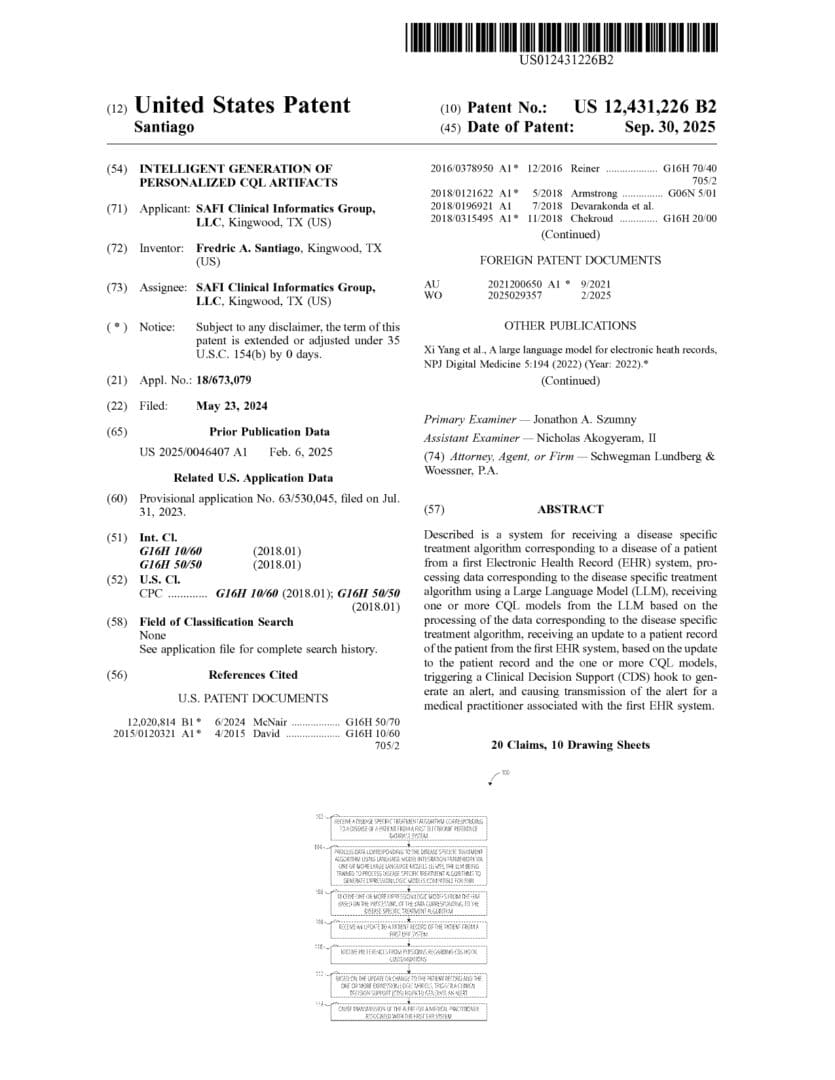
U.S. Patent No. 12,431,226 — “Intelligent Generation of Personalized CQL Artifacts” — changes that.
It introduces an AI-enabled framework that allows clinicians and research professionals to create executable CDS logic in plain language, automatically translated into standard formats usable across EHRs and research systems.

Value Proposition
Bridging the gap between clinical reasoning and machine logic
The system interprets ordinary clinical or research language and generates fully functional, standards-compliant logic behind the scenes.
Clinicians can now author CDS content themselves—without coding, training in logic modeling, or dependence on technical teams.
Transforming policy investment into everyday usability
By extending the capabilities of the AHRQ CDS Authoring Tool, this invention activates a federal resource that already exists but has seen limited adoption.
It translates government infrastructure into practical value for health systems, universities, and public-private research networks.
Expanding access and collaboration
The technology empowers physicians, nurses, pharmacists, and researchers to develop and share CDS modules tailored to their patient populations.
It opens new pathways for collaboration among academic medical centers, clinical informatics programs, and community hospitals.
Clinical Applications
- Provider-Centered CDS:
Clinicians can instantly generate treatment rules, order-set checks, discharge-planning guidance, and quality-measure logic—directly within their workflow—without technical mediation. - Patient-Centered CDS:
The same framework supports patient-facing alerts, education modules, and remote- monitoring tools, allowing personalized guidance to be delivered through mobile apps or patient portals. - Education and Workforce Development:
Universities can use the platform to train future clinicians and informaticists on standards-based CDS and interoperability without requiring programming expertise.

Research and Academic Applications
Computable Research Criteria
The invention converts narrative inclusion and exclusion criteria into machine-readable logic, enabling faster, more accurate identification of research participants.
Clinical-Trial and Real-World Evidence (RWE) Enablement
Researchers can design and test computable study definitions, simulate trial feasibility, and extract real-world cohorts directly from EHR data using FHIR standards.
Accelerated Innovation
Academic and translational research centers gain a “no-code” platform for prototyping and sharing computable studies, reducing the time from concept to implementation.
Regulatory Alignment
All generated logic adheres to nationally recognized standards (FHIR, CQL, CDS Hooks), ensuring interoperability and reproducibility of research finding.
Strategic Importance
- Clinician Empowerment:
Puts CDS and research-logic creation back into the hands of healthcare professionals. - Policy Alignment:
Directly supports AHRQ, ONC, and CMS mandates for clinician- friendly, shareable CDS content. - Academic Engagement:
Offers universities a ready-made tool for teaching, research, and applied informatics innovation. - AI Leadership:
Demonstrates how generative AI can safely augment, not replace, human expertise in medicine and research.
Summary Statement
This technology transforms CDS authoring from a specialized programming task into an intuitive, clinician- and researcher-driven process.
It bridges the gap between national policy and daily practice, enabling hospitals, universities, and innovators to create and share intelligent, standards-based decision support.
By unlocking a federal platform and extending it to both clinical care and biomedical research, this invention positions SAFI Clinical Informatics Group as a catalyst for the next generation of AI-assisted, clinician-authored decision support.